A real nest
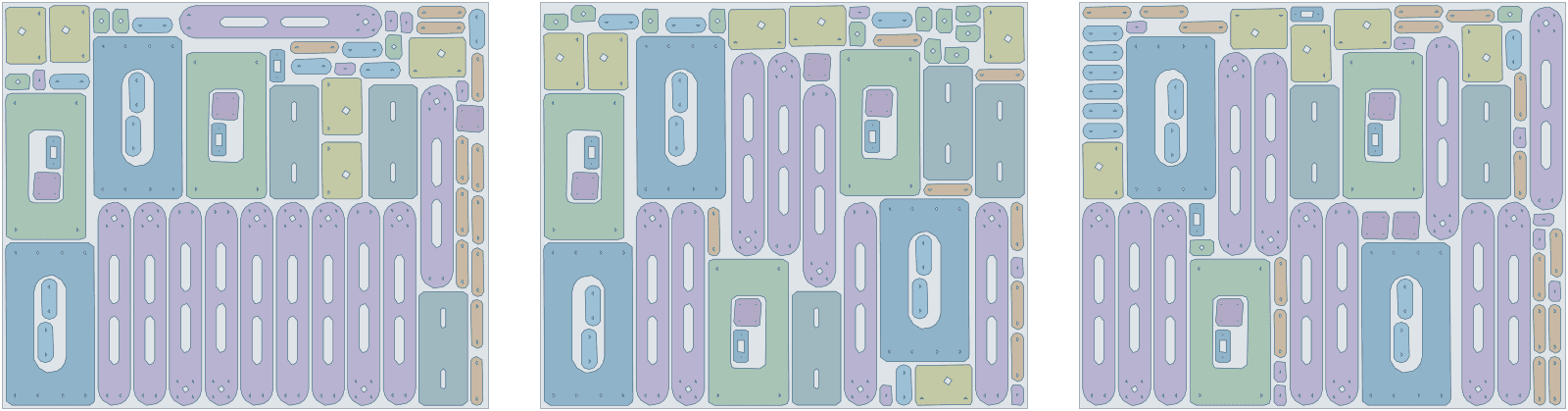
7 whole 10-inch frames from 3 carbon plates, 74% used
A 10-inch quadcopter frame routed from 3 mm carbon fibre plate, 23 parts a frame: four straight arms with the motor holes in their rounded ends and lightening slots, top and bottom plates with their cut-outs, camera side plates, a battery plate, and the small mounts, braces and landing feet, every bolt hole a real cut-out. Parts turn in 90° steps, which keeps the plate's fibres along each arm, and never flip, so the finished face stays up; 4 mm between parts leaves room for the router bit. The stack adapters, connector mounts and other small parts are cut from inside the top and bottom plates' cut-outs. The parts' outlines cover 85% of the plates; 11% is their own bolt holes and cut-outs, which count as waste in the figure above. The order asked for more frames than 3 plates hold, so with prefer complete sets Lescut placed 7 whole frames and filled the leftover with 27 parts of the next ones.
| Part | Per set | Rotation | Tilt | Mirror |
|---|---|---|---|---|
| bottom-plate · 9 cut-outs | 1 | 90° steps | – | no |
| top-plate · 5 cut-outs | 1 | 90° steps | – | no |
| arm · 9 cut-outs | 4 | 90° steps | – | no |
| battery-plate · 2 cut-outs | 1 | 90° steps | – | no |
| camera-plate · 3 cut-outs | 2 | 90° steps | – | no |
| stack-adapter · 4 cut-outs | 1 | 90° steps | – | no |
| landing-foot · 2 cut-outs | 4 | 90° steps | – | no |
| arm-brace · 2 cut-outs | 4 | 90° steps | – | no |
| connector-mount · 3 cut-outs | 1 | 90° steps | – | no |
| antenna-mount · 1 cut-out | 2 | 90° steps | – | no |
| led-mount · 1 cut-out | 2 | 90° steps | – | no |
- complete sets
- 7
- material used
- 74.1%
- sheets used
- 3 of 3
- gap between parts
- 4 mm
- search time
- 2 min
Want to see how Lescut nests your own parts? Start a free trial or send us your parts.
A real nest
3 fixed-wing UAV airframes on 5.95 m of 1000 mm carbon prepreg, 88% used
A 2 m fixed-wing survey UAV in 2x2 twill carbon prepreg: upper and lower wing skins, fuselage halves and V-tail skins, each left and right, a tail boom wrap, root doublers and servo patches, 26 plies an airframe. Skins keep the weave one way and only turn half round; doublers and patches turn in 90° steps and fill the gaps between the tapered skins. Its first marker was 7.13 m; the search kept going and cut it to 5.95 m.

| Part | Per set | Rotation | Tilt | Mirror |
|---|---|---|---|---|
| wing-skin-r | 2 | 180° steps | – | no |
| wing-skin-l | 2 | 180° steps | – | no |
| fuselage-half-r | 2 | 180° steps | – | no |
| fuselage-half-l | 2 | 180° steps | – | no |
| boom-wrap | 2 | 180° steps | – | no |
| vtail-skin-r | 2 | 180° steps | – | no |
| vtail-skin-l | 2 | 180° steps | – | no |
| root-doubler | 4 | 90° steps | – | no |
| servo-patch | 8 | 90° steps | – | no |
- parts placed
- 78
- material used
- 88.4%
- marker length
- 5.95 m
- gap between parts
- 2 mm
- search time
- 5 min
Want to see how Lescut nests your own parts? Start a free trial or send us your parts.
The problem
Small series, fast changes and dear carbon
Carbon plate is sold by the sheet
Frames are routed from plates of a few sizes, and every plate costs the same however much of it ends up as frames. A frame more per plate is a plate less per batch.
Designs change every few weeks
Arm lengths, camera mounts and payload plates change with each revision and each customer. Nesting by hand in the router's CAM for every change is where the time goes.
Two materials, two kinds of nest
A multirotor's frame comes from plates, a fixed-wing airframe from prepreg rolls, and many makers cut both. Each needs its own rules: sheets and kits for plates, fibre angles and marker length for prepreg.
Applications
Where drone and uav nesting software is used
FPV and multirotor frames
Arms, plates and mounts routed from carbon fibre plate, nested as whole frames.
Heavy-lift and agricultural drones
Larger arms, payload plates and landing gear parts on the same plates.
Fixed-wing UAV airframes
Wing, fuselage and tail skins in carbon or glass prepreg, nested on the roll.
VTOL and eVTOL
Airframe plies at their fibre angle, with ply numbers kept.
Payload and gimbal plates
Small plate parts nested with the frames in one job.
Robot and RC parts
Chassis plates and brackets in carbon, G10 or aluminium plate.
Settings to start from
A starting point for drones and uavs
Rules per part come from text in your file (NAME, QTY, GRADE, ROT, TILT, FLIP) or the parts table; the rest is saved once in a nesting profile that starts every job.
| For | Setting | Why |
|---|---|---|
| Carbon plate parts | ROT:90, FLIP:N | 90° steps keep the plate's fibres along each arm; the finished face stays up |
| Gap | bit diameter + 1 mm | about 4 mm for a 3.175 mm router bit |
| Frames | 1 set = 1 frame | with prefer complete sets, every plate holds whole frames first |
| Plate sizes | nesting profile, with prices | fewest plates, or the lowest cost when sizes are priced |
| Prepreg skins | ROT:180, FLIP:N | the visible weave runs one way on every skin |
| Doublers and patches | ROT:90 | under the skin, 90° steps fill the gaps |
Preparing your files
From your CAD to Lescut
Lescut reads DXF and SVG. Each closed outline is a part and each closed outline inside it a cut-out; marks and texts on other layers travel with the part.
- Draw bolt holes, slots and lightening cut-outs as closed outlines inside the part; small parts may be nested in the large cut-outs.
- Keep plate parts of one thickness in one file: 3 mm plates and 5 mm arms are cut from different plates, so they are separate jobs.
- For prepreg skins, draw each ply as it lies on the roll with the warp along X and no grain line.
Good to know
What Lescut does not do
- Lescut does not make tool paths, lead-ins or tabs; your router's CAM does, from the nested DXF.
- Plates of one thickness per job, and fabric and plate are separate organizations, each with its own plan.
- It does not design frames or flatten airframe plies.
Savings
What better nesting is worth in drones and uavs
The same parts need the same area of material however they are nested, so a better yield means buying less of it. Carbon fibre plate is sold by the sheet at many times the price of plywood, and frames leave waste between arms and around plates. The starting figures are an example for a maker routing 3 mm carbon plate of 1000 × 600 mm at about €300 a plate; enter your own.
65% today → 71.0% with nesting. This is your assumption; the trial measures it on your own files.
Engine time: how the plan is chosen
A day's order of sheets nests well in a job of 1 to 5 minutes; longer jobs can save a further sheet. Your monthly volume divided by this gives the jobs a month, and the calculator picks the cheapest plan whose engine minutes and job length cover them.
The yield gain is your assumption; the trial measures it on your own files. More on how the sheet savings calculator works and how the fabric savings calculator works.
Pricing
Drone and UAV nesting software plans, free for 7 days
Every plan starts with a 7-day free trial with engine minutes to nest your own parts against the sheets you would have used. You are charged only if you keep the plan. Sheet and fabric are separate organizations, each with its own plan.
Not sure yet whether we read your files? Send us a nest you cut first: we nest the same parts for free and send you a comparison, no card needed.
Sheet Enterprise
from €199 per month
1,200 engine minutes a month
about 1,200 nests at 1 minute each
up to 16 vCPU per job, jobs up to 30 min
- Everything in Sheet Pro
- 5× the engine minutes and jobs up to 30 min
- 10 jobs at a time, each on its own machine with up to 16 vCPU
- Priority queue
- Priority support
- Unlimited team members
- SSO (planned)
€0 for 7 days. Cancel any time.
Extra engine minutes are €0.50 each, with up to 30% off. All sheet nesting plans and fabric nesting plans.
Drone and UAV nesting software: questions
Can Lescut nest carbon fibre plate for drone frames?
Yes. Carbon plate is nested like any sheet: parts with their holes and slots, the gap your router bit needs, on the plate sizes you have, for the most complete frames on the fewest plates.
Are small parts cut from inside larger ones?
Yes. A closed outline inside a part is a cut-out, and smaller parts of the job are nested inside it when they fit with the gap.
Can I nest prepreg plies for fixed-wing airframes too?
Yes, as fabric nesting: skins, doublers and patches at their fibre angle on the shortest length of roll, in a separate organization with a fabric plan.
Can our production system start jobs automatically?
Yes, with the REST API on Pro and Enterprise plans: send the parts, start the job and fetch the cutting files.