A real nest
2 saddle and bridle sets from one scanned hide, 75% of the leather used
An English saddle's flaps, skirts and seat with stirrup leathers and girth straps, and a bridle with headpiece, cheekpieces, noseband and reins: 28 pieces a set, on hide H-2026-0011, scanned from a real hide. Flaps, seat and noseband take prime leather; straps run along the backbone within 2°; keepers turn freely. The order asked for more sets than this hide holds, so with prefer complete sets Lescut placed 2 whole sets and filled the leftover with 54 parts of the next ones.
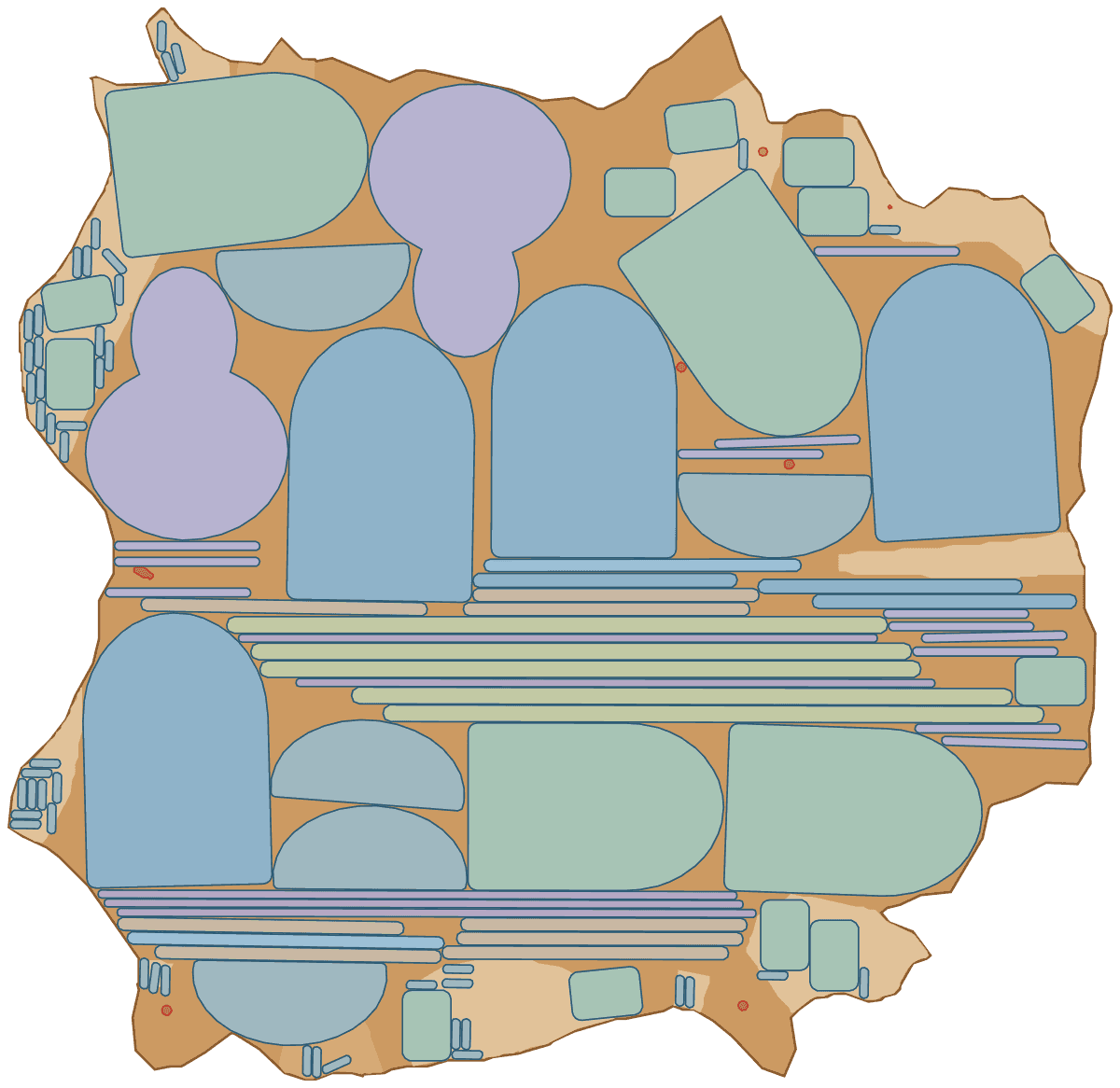
| Part | Per set | Grade | Rotation | Tilt | Mirror |
|---|---|---|---|---|---|
| saddle-flap | 2 | prime | 180° steps | ±5° | no |
| sweat-flap | 2 | C | free | – | no |
| seat | 1 | prime | 180° steps | ±3° | no |
| skirt | 2 | B | 180° steps | ±5° | no |
| stirrup-leather | 2 | B | 180° steps | ±2° | no |
| rein | 2 | B | 180° steps | ±2° | no |
| headpiece | 1 | B | 180° steps | ±2° | no |
| girth-strap | 3 | B | 180° steps | ±2° | no |
| noseband | 1 | prime | 180° steps | ±2° | no |
| billet-guard | 2 | C | free | – | no |
| cheekpiece | 2 | B | 180° steps | ±2° | no |
| keeper | 8 | C | free | – | no |
- complete sets
- 2
- material used
- 75.0%
- hides used
- 1 of 1
- gap between parts
- 2 mm
- search time
- 2 min
Want to see how Lescut nests your own parts? Start a free trial or send us your parts.
The problem
Long straps and the firmest leather
Straps must follow the backbone
Stirrup leathers and reins stretch if they are cut across the hide. They need long, straight runs along the backbone, and there are only so many on a hide.
Flaps show every mark
Saddle flaps and seats are large and seen; a scar or a brand mark makes them seconds. They need the clean prime leather that straps also want.
Thick, expensive leather
Saddle and bridle leather is among the dearest by area, and a hand layout that runs out of straight backbone leather opens another hide.
Applications
Where saddlery nesting software is used
English saddles
Flaps, skirts, seats and panels on prime leather, with stirrup leathers along the backbone.
Western saddles
Skirts, fenders and jockeys: large pieces with clear grade needs and straps from the same hide.
Bridles and headstalls
Headpieces, cheekpieces, nosebands and reins: long, narrow and along the hide.
Driving harness
Traces, breastplates and straps in harness leather, nested with their direction rules.
Dog collars and leads
Narrow straps that fill the backbone runs between larger pieces.
Belts and straps
Belt blanks and straps from bridle and saddle leather.
Settings to start from
A starting point for saddlery and tack
Rules per part come from text in your file (NAME, QTY, GRADE, ROT, TILT, FLIP) or the parts table; the rest is saved once in a nesting profile that starts every job.
| For | Setting | Why |
|---|---|---|
| Flaps, seat, noseband | GRADE:A, ROT:180, TILT:3–5 | clean prime leather, along the hide |
| Straps and reins | GRADE:B, ROT:180, TILT:2 | firm leather along the backbone |
| Keepers and small parts | GRADE:C, ROT:ANY | fill the gaps |
| Punch holes | DRILL layer | travel with the strap |
| Gap | 2–3 mm | the knife on thick leather |
Preparing your files
From your CAD to Lescut
Saddlery patterns from CAD or digitised templates, as DXF or SVG. Each closed outline is a piece.
- Draw punch holes on DRILL and stitch lines on STITCH; they are marked or punched, not cut as outlines.
- Scan hides with the backbone along the same axis every time, so ROT:180 keeps straps along it.
- Mark belly and shoulder as lower grades on the scan if your scanner does not grade them.
Good to know
What Lescut does not do
- Lescut needs scanned hides; it does not digitise them from photos.
- It does not skive, split or emboss: it nests and returns cutting files.
Savings
What better nesting is worth in saddlery and tack
The same parts need the same area of material however they are nested, so a better yield means buying less of it. Saddle and bridle leather is thick and among the dearest by area. The starting figures are an example for a saddlery cutting whole hides; enter your own.
62% today → 66.0% with nesting. This is your assumption; the trial measures it on your own files.
Engine time: how the plan is chosen
A batch of about 10 hides nests well in a 10-minute job; a single hide waiting on the table needs 10 to 30 seconds. Your monthly volume divided by this gives the jobs a month, and the calculator picks the cheapest plan whose engine minutes and job length cover them.
The yield gain is your assumption; the trial measures it on your own files. More on how the leather yield calculator works.
Pricing
Saddlery nesting software plans, free for 7 days
Every plan starts with a 7-day free trial with engine minutes to nest your own parts against the hides you would have used. Add a card when you sign up; you are charged only if you keep the plan.
Leather Enterprise
from €890 per month
4,500 engine minutes, up to 16 vCPU per job, jobs up to 60 min
- Everything in Leather Pro
- 5× the engine minutes and jobs up to 60 min for large orders
- 10 jobs at a time, each on its own machine with up to 16 vCPU
- Priority queue
- Unlimited team members
- SSO (planned)
€0 for 7 days. Card required. Cancel any time.
Extra engine minutes are €0.50 each, with up to 30% off. All leather nesting plans.
Saddlery nesting software: questions
Can Lescut keep straps along the backbone?
Yes. A strap with ROT:180 keeps its grain line along the hide, or the direction it is drawn in when it has none, turned half round at most, and TILT lets it turn a degree or two off it. Scan hides with the backbone along one axis.
Can flaps and straps compete for the best leather?
Give each its grade: flaps prime, straps grade B along the backbone. The engine places each on leather of its grade or better, so straps do not use up the prime leather the flaps need unless it is spare.
Does it work for Western saddles?
Yes. Any pattern of closed outlines nests the same way: skirts, fenders, jockeys and seats with their grades and directions.