A real nest
1 sofa from one scanned hide, 80% of the leather used
A sofa, 22 cover pieces each, nested on hide H-2026-0011, scanned from a real hide. Seat tops are grade B with a prime area where they show; arm fronts are prime; the outside back and gussets take grade C. Tabs and patches turn freely and fill the leather between the panels. The order asked for more sofas than this hide holds, so with prefer complete sets Lescut placed 1 whole sofa and filled the leftover with 25 parts of the next ones.
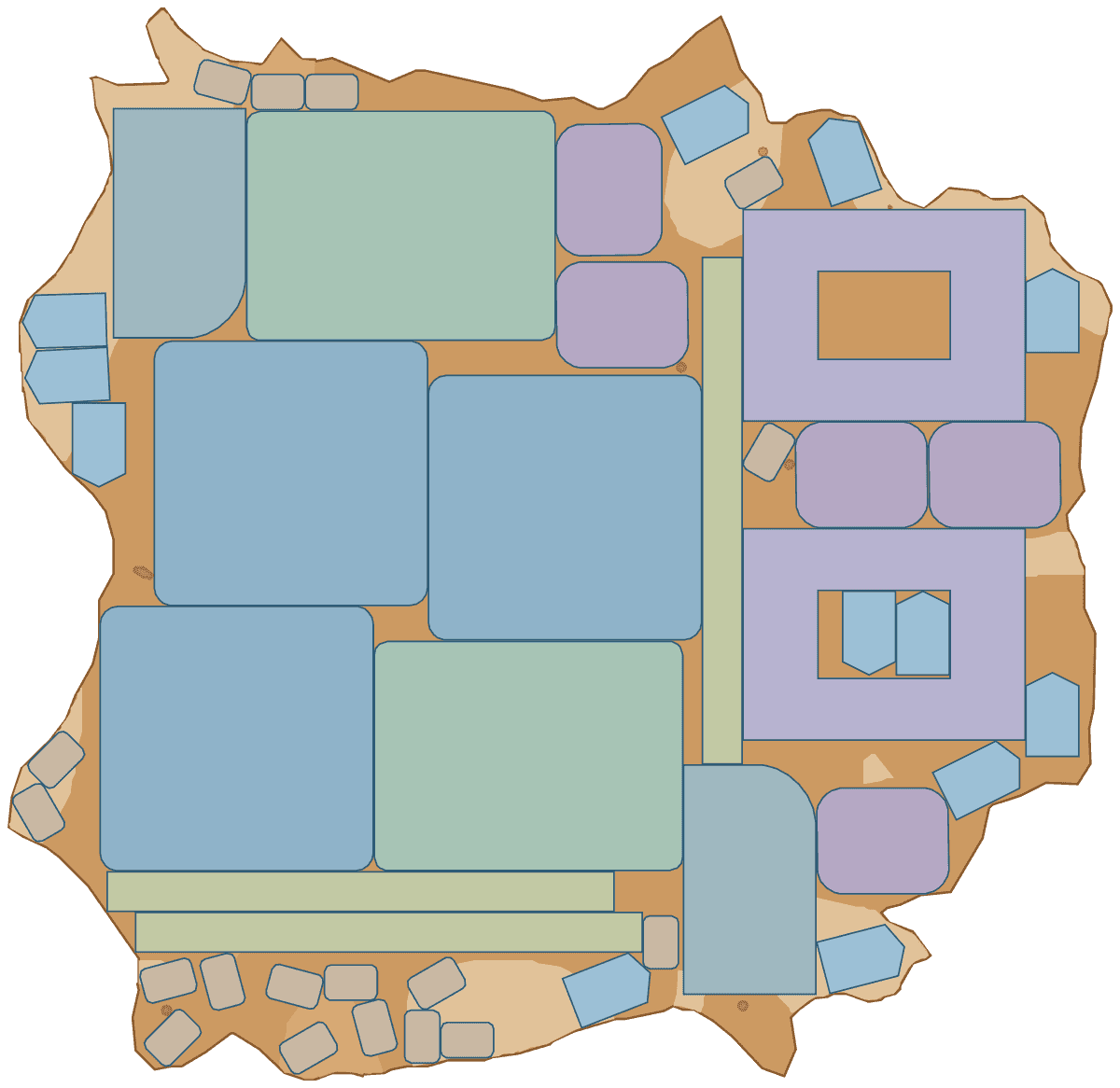
| Part | Per set | Grade | Rotation | Tilt | Mirror |
|---|---|---|---|---|---|
| seat-top | 2 | B + prime area | 180° steps | – | no |
| back-panel | 2 | B | 90° steps | – | no |
| outer-back · 1 cut-out | 1 | C | 90° steps | – | no |
| arm-side | 2 | C | 90° steps | – | allowed |
| gusset | 3 | C | 90° steps | – | no |
| arm-front | 2 | prime | 90° steps | – | no |
| patch | 4 | C | free | – | no |
| tab | 6 | C | 15° steps | – | no |
- complete sets
- 1
- material used
- 79.5%
- hides used
- 1 of 1
- gap between parts
- 2 mm
- search time
- 2 min
Want to see how Lescut nests your own parts? Start a free trial or send us your parts.
A real nest
The same sofa in fabric: 3 sofas on 5.96 m of a 1400 mm roll, 94% used
The same 22 cover pieces a sofa, 3 sofas on upholstery fabric: every piece face up, along the fabric's direction or turned half round, so a plain weave or a non-directional pattern reads the same on every panel. Fabric has no grades or shade lots; the goal is the shortest marker. Its first marker was 6.39 m; the search kept going and cut it to 5.96 m.
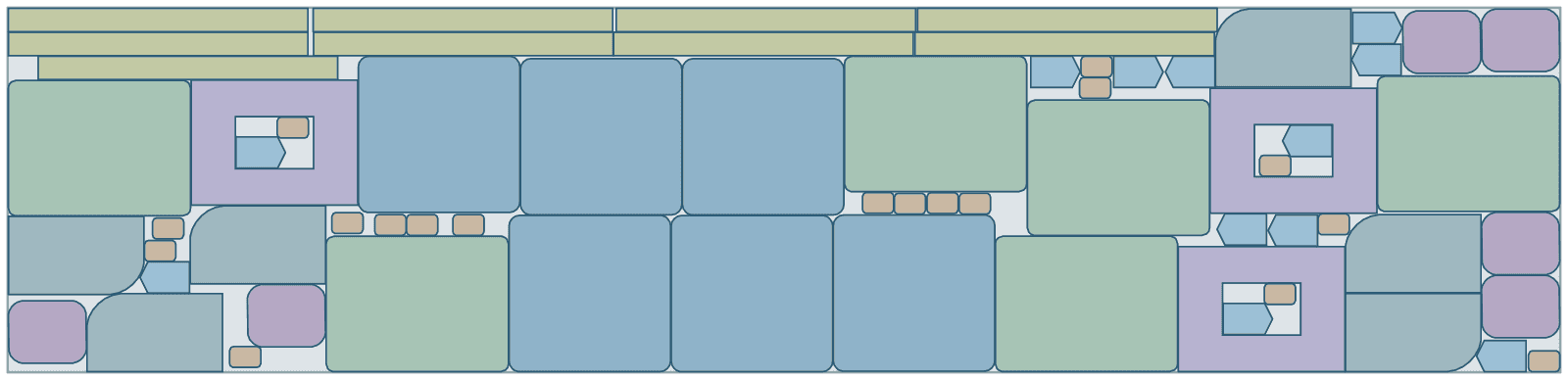
| Part | Per set | Rotation | Tilt | Mirror |
|---|---|---|---|---|
| seat-top | 2 | 180° steps | – | no |
| back-panel | 2 | 180° steps | – | no |
| outer-back · 1 cut-out | 1 | 180° steps | – | no |
| arm-side | 2 | 180° steps | – | allowed |
| gusset | 3 | 180° steps | – | no |
| arm-front | 2 | 180° steps | – | no |
| patch | 4 | 180° steps | – | no |
| tab | 6 | 180° steps | – | no |
- parts placed
- 66
- material used
- 93.7%
- marker length
- 5.96 m
- gap between parts
- 2 mm
- search time
- 5 min
Want to see how Lescut nests your own parts? Start a free trial or send us your parts.
The problem
Large panels, visible faces and matching shades
Panels take a big share of a hide
A seat cushion or an outside back can take a fifth of a hide. Every panel placed decides what is left for the next, so a layout made panel by panel by eye regularly needs one hide more than the order does.
Not every face needs prime leather
Seats, backs and arm fronts are seen and touched; the outside back against the wall, the deck under the cushions and the flaps stapled to the frame are not. Using lower grades there is what makes a hide go further.
One sofa, one shade
Hides from different tannings differ in shade. A sofa whose arm and seat come from different lots shows it in the showroom, so each model's covers must come from hides that match.
Fabric with a direction
Velvet and chenille have a pile, prints and weaves a direction, stripes and checks a repeat. A cover cut the wrong way round shows at once, and every such rule takes freedom from the marker.
Applications
Where upholstery nesting software is used
Sofas and armchairs
Seats, backs and arm fronts on prime leather or the fabric roll, whole models per shade lot.
Recliners and cinema seating
Many repeated cover sets, nested by batch with their grades.
Beds and headboards
Large panels that need clean leather or a fabric's full width.
Contract seating
Hotel, office and restaurant chairs in volume, leather or fabric.
Marine and yacht upholstery
Cushions and bench covers in leather or marine fabric.
Aircraft and rail seats
Seat covers held to tight grade and traceability rules.
Settings to start from
A starting point for upholstery
Rules per part come from text in your file (NAME, QTY, GRADE, ROT, TILT, FLIP) or the parts table; the rest is saved once in a nesting profile that starts every job.
| For | Setting | Why |
|---|---|---|
| Seat tops, inside backs, arm fronts | GRADE:A, or GRADE:B with a QZ_A area | prime where it is seen and sat on; lower grades under seams and staples |
| Outside backs, decks, gussets | GRADE:C | out of sight, so they use the hide's weaker zones |
| Rotation | ROT:90 or ROT:180 per piece | keep panels along the backbone where the leather's stretch matters; free rotation for tabs and patches |
| Sets mode | strict complete sets | each sofa from one shade lot, no half sofas |
| Shade lots | group label per hide, or batch as one lot | the hides a sofa may combine |
| Goal | fewest hides, or lowest leather cost | lowest cost uses each hide's own price, when hides of one batch differ |
| Fabric with pile or a one-way print | ROT:0, FLIP:N | every panel the same way up |
| Plain or non-directional fabric | ROT:180, FLIP:N | half turns fill more of the roll; the face stays up |
| Striped or checked fabric | repeat and match points | seat, back and arm panels line up across seams |
Preparing your files
From your CAD to Lescut
Upholstery patterns come from furniture CAD or from digitised card patterns, as DXF or SVG. Each closed outline on a cut layer becomes a piece.
- Draw a prime area inside a large panel on a QZ_A layer: the rest of the panel may then use the panel's own grade.
- Put notches on NOTCH and drill marks on DRILL so the cutter marks them, and frames or title blocks on a layer an import profile ignores.
- Give each piece NAME, QTY, GRADE and ROT as text inside it, or edit them in the parts table after upload.
Good to know
What Lescut does not do
- Lescut does not reserve hides: two jobs can plan the same batch, so plan one batch at a time.
- Remnants are reported per job; they are not stored as stock for later jobs.
- Leather and fabric are separate Lescut organizations, each with its own plan; your login can belong to both.
- Matching places pieces on stripe and plaid repeat lines; large motifs that must be centred on a cushion are not placed.
Savings
What better nesting is worth in upholstery
The same parts need the same area of material however they are nested, so a better yield means buying less of it. In upholstery the cover is the largest material cost, whether hides or fabric by the metre. Switch between leather and fabric; the starting figures are an example for a mid-sized furniture maker.
70% today → 73.0% with nesting. This is your assumption; the trial measures it on your own files.
Engine time: how the plan is chosen
A batch of about 10 hides nests well in a 10-minute job; a single hide waiting on the table needs 10 to 30 seconds. Your monthly volume divided by this gives the jobs a month, and the calculator picks the cheapest plan whose engine minutes and job length cover them.
The yield gain is your assumption; the trial measures it on your own files. More on how the leather yield calculator works and how the fabric savings calculator works.
Pricing
Upholstery nesting software plans, free for 7 days
Every plan starts with a 7-day free trial with engine minutes to nest your own parts against the hides you would have used. Add a card when you sign up; you are charged only if you keep the plan. Leather and fabric are separate organizations, each with its own plan.
Extra engine minutes are €0.50 each, with up to 30% off. All leather nesting plans and fabric nesting plans.
Upholstery nesting software: questions
Can I keep a whole sofa within one shade lot?
Yes. Label the hides of each lot with a group on the batch page, or treat each batch as one lot, and choose strict complete sets: every sofa then comes from hides of one group, and no group holds half a sofa.
What if the batch cannot cover the whole order?
Prefer complete sets places as many whole sofas as fit, then puts pieces of further sofas only in leftover leather on hides already in use. Strict places whole sofas only. Maximum utilisation places as many pieces as fit. What is not placed is listed in the result.
Can I use the leftover leather?
At the end of a job, the hides the order uses least get their pieces pushed to one side, so the free leather is one piece. Each remnant of at least 0.25 m² is shown on the hide's card and in the drawings.
Do you nest fabric upholstery too?
Yes. The same model's pieces nest on the fabric roll for the shortest marker, with pile and print direction kept and stripes and plaids matched. An organization works in one material, so fabric is a second Lescut organization under the same login.