A real nest
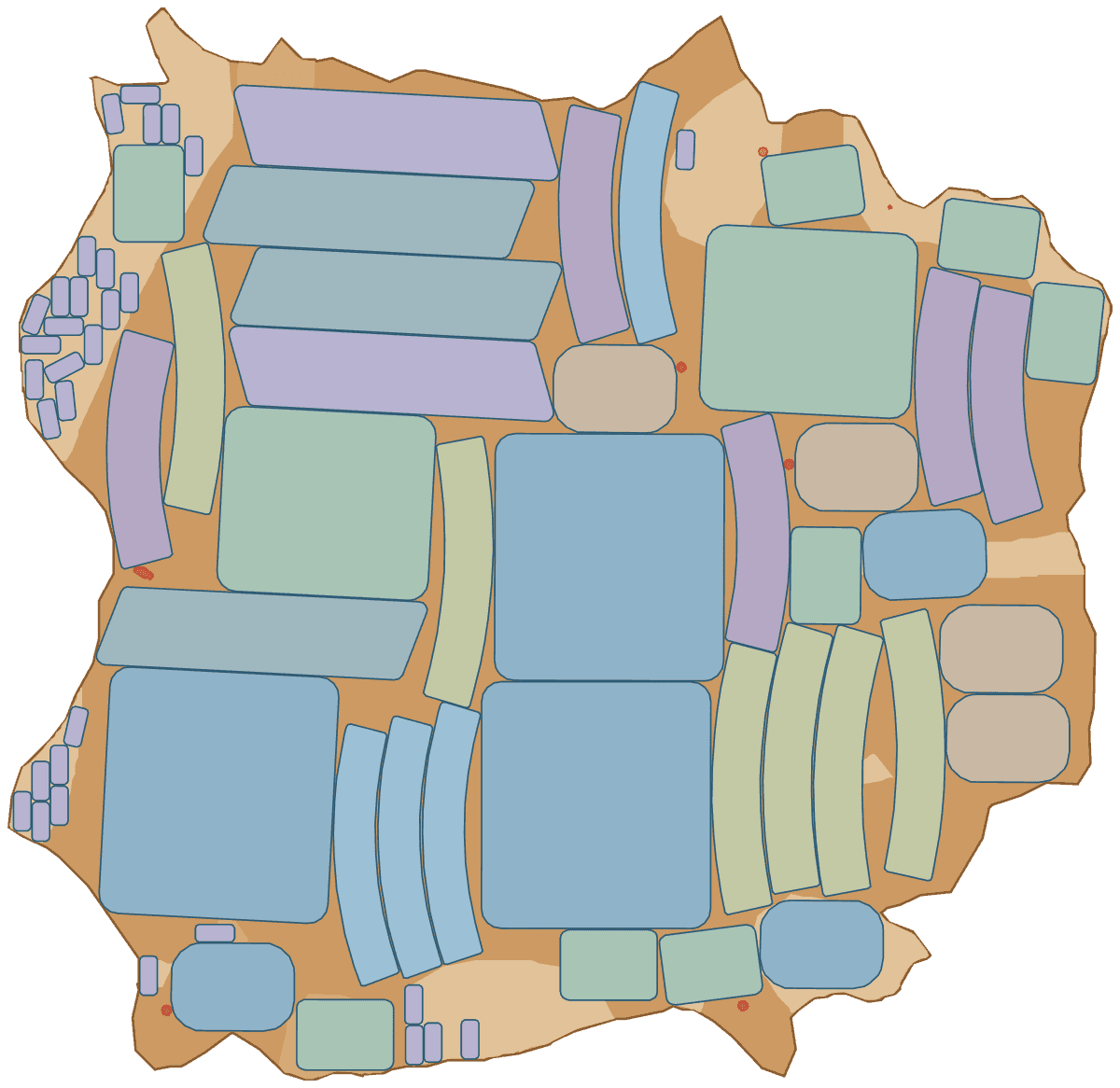
Seats, doors and wheels for 1 car from one scanned hide, 77% used
Front seats, door inserts and steering wheel for one car, 32 pieces, on hide H-2026-0011, scanned from a real hide. The seat inserts are grade C at the seam allowance and prime in the visible field; headrest fronts and the wheel rim are prime; bolsters and door inserts grade B. Every piece stays along the backbone within 3°. The order asked for more cars than this hide holds, so with prefer complete sets Lescut placed 1 whole car and filled the leftover with 40 parts of the next ones.
| Part | Per set | Grade | Rotation | Tilt | Mirror |
|---|---|---|---|---|---|
| backrest-insert | 2 | C + prime area | 180° steps | ±3° | no |
| cushion-insert | 2 | C + prime area | 180° steps | ±3° | no |
| door-insert-l | 2 | B | 180° steps | ±3° | no |
| door-insert-r | 2 | B | 180° steps | ±3° | no |
| bolster-back | 4 | B | 180° steps | ±3° | no |
| bolster-cushion | 4 | B | 180° steps | ±3° | no |
| wheel-rim | 2 | prime | 180° steps | ±3° | no |
| headrest-front | 2 | prime | 180° steps | ±3° | no |
| headrest-back | 2 | C | 180° steps | ±3° | no |
| pocket-lining | 2 | D | free | – | no |
| trim-tab | 8 | D | free | – | no |
- complete sets
- 1
- material used
- 76.6%
- hides used
- 1 of 1
- gap between parts
- 2 mm
- search time
- 2 min
Want to see how Lescut nests your own parts? Start a free trial or send us your parts.
The problem
Quality zones inside a piece, and every piece accountable
The grade changes within a piece
The face of a seat insert must be flawless; its seam allowance disappears into the seam. Treating the whole piece as prime wastes good leather; treating it as a lower grade risks a mark in view of the driver.
Long, curved pieces
Bolsters, door inserts and wheel covers are long and curved. They interlock with each other when placed well and leave long slivers of waste when they are not.
Traceability and confidentiality
Interior suppliers answer for every part they ship, and OEM patterns are confidential. The nesting step has to record where each piece came from and must not become a copy of the customer's patterns.
Applications
Where automotive leather nesting software is used
Car seat covers
OEM and aftermarket covers: inserts, bolsters and headrests with graded sub-zones.
Steering wheels and gear knobs
Prime leather wheel covers, long curved pieces along the backbone.
Door panels and dashboards
Inserts and trim pieces, left and right drawn apart.
Aircraft seats and cabin interiors
Dress covers and headrests with every piece traced to its hide.
Rail and bus seating
Repeated cover sets nested by batch.
Motorcycle seats
Seat covers from thick, graded leather.
Airbags
Cut-and-sew airbag panels from the fabric roll.
Settings to start from
A starting point for automotive interiors
Rules per part come from text in your file (NAME, QTY, GRADE, ROT, TILT, FLIP) or the parts table; the rest is saved once in a nesting profile that starts every job.
| For | Setting | Why |
|---|---|---|
| Seat inserts | GRADE:C with a QZ_A field | prime in the visible field, grade C under the seam allowance |
| Wheel rim, headrest fronts | GRADE:A | touched and seen all the time |
| Bolsters, door inserts | GRADE:B | visible, but a grade less than the inserts |
| Direction | ROT:180, TILT:3 | along the backbone with a small tolerance, per OEM specification |
| Batches | do not mix batches in a set | one car's leather from one batch |
| Patterns | API with inline geometry | no pattern file stored; the job's geometry is deleted with it, or 24 h after it ends |
Preparing your files
From your CAD to Lescut
Trim CAD exports the flattened pieces as DXF. Each closed outline on a cut layer is a piece; graded areas and marks go on their own layers.
- Draw the visible field of an insert on QZ_A inside the piece, and give the piece its seam-allowance grade.
- Put perforation fields on PUNCH or DRILL and stitch lines on STITCH: they travel with the piece to the cutting file.
- Left and right door inserts are mirror images: draw both, flip off.
Good to know
What Lescut does not do
- Lescut needs scanned hides with grade zones; the grading rules themselves come from your scanner or inspection.
- It nests and returns cutting files; it does not drive the cutter or plan the cut sequence.
- Reselling nesting to your own customers through the API runs on partner terms.
Savings
What better nesting is worth in automotive interiors
The same parts need the same area of material however they are nested, so a better yield means buying less of it. Automotive hides are bought in large lots at a high price, so a single point of yield is worth a lot over a programme. The starting figures are an example for an interior supplier; enter your own.
68% today → 70.0% with nesting. This is your assumption; the trial measures it on your own files.
Engine time: how the plan is chosen
A batch of about 10 hides nests well in a 10-minute job; a single hide waiting on the table needs 10 to 30 seconds. Your monthly volume divided by this gives the jobs a month, and the calculator picks the cheapest plan whose engine minutes and job length cover them.
The yield gain is your assumption; the trial measures it on your own files. More on how the leather yield calculator works.
Pricing
Automotive leather nesting software plans, free for 7 days
Every plan starts with a 7-day free trial with engine minutes to nest your own parts against the hides you would have used. Add a card when you sign up; you are charged only if you keep the plan.
Leather Enterprise
from €890 per month
4,500 engine minutes, up to 16 vCPU per job, jobs up to 60 min
- Everything in Leather Pro
- 5× the engine minutes and jobs up to 60 min for large orders
- 10 jobs at a time, each on its own machine with up to 16 vCPU
- Priority queue
- Unlimited team members
- SSO (planned)
€0 for 7 days. Card required. Cancel any time.
Extra engine minutes are €0.50 each, with up to 30% off. All leather nesting plans.
Automotive leather nesting software: questions
Can a piece need prime leather on its face but allow a lower grade at the seam?
Yes. Give the piece the lower grade and draw the area that must be prime on a QZ_A layer inside it. Lescut checks each graded area against the hide's zones separately.
Can Lescut connect to our production system?
Yes, through the REST API on Pro and Enterprise plans: start jobs, follow their progress and fetch results and reports. API keys are made by organization owners and admins.
Do you keep our OEM patterns?
Not if you send them with the job. An API job can carry its parts and hides as point lists: no file is stored, the geometry lives only as part of the job and is deleted with it, or 24 hours after it ends.
Can every cut piece be traced to its hide?
Yes. The job report lists each piece with its batch and hide, and each cutting file carries a text naming the job and hide.