A real nest
132 gaskets from 2 sheets, 62% of the gasket sheet used
Full-face flange gaskets from DN15 to DN300 with their bolt holes, rectangular cover gaskets and sealing washers, sized as a gasket cutter plans an order, each bore taking the next gasket down: 80 gaskets an order, on 1500 × 1500 mm sheets with a 3 mm gap. Smaller gaskets are cut from the bores of larger ones; round gaskets turn freely. The order asked for more than 2 sheets hold; gaskets come in no sets, so the job used maximum utilisation and placed as many as fit.
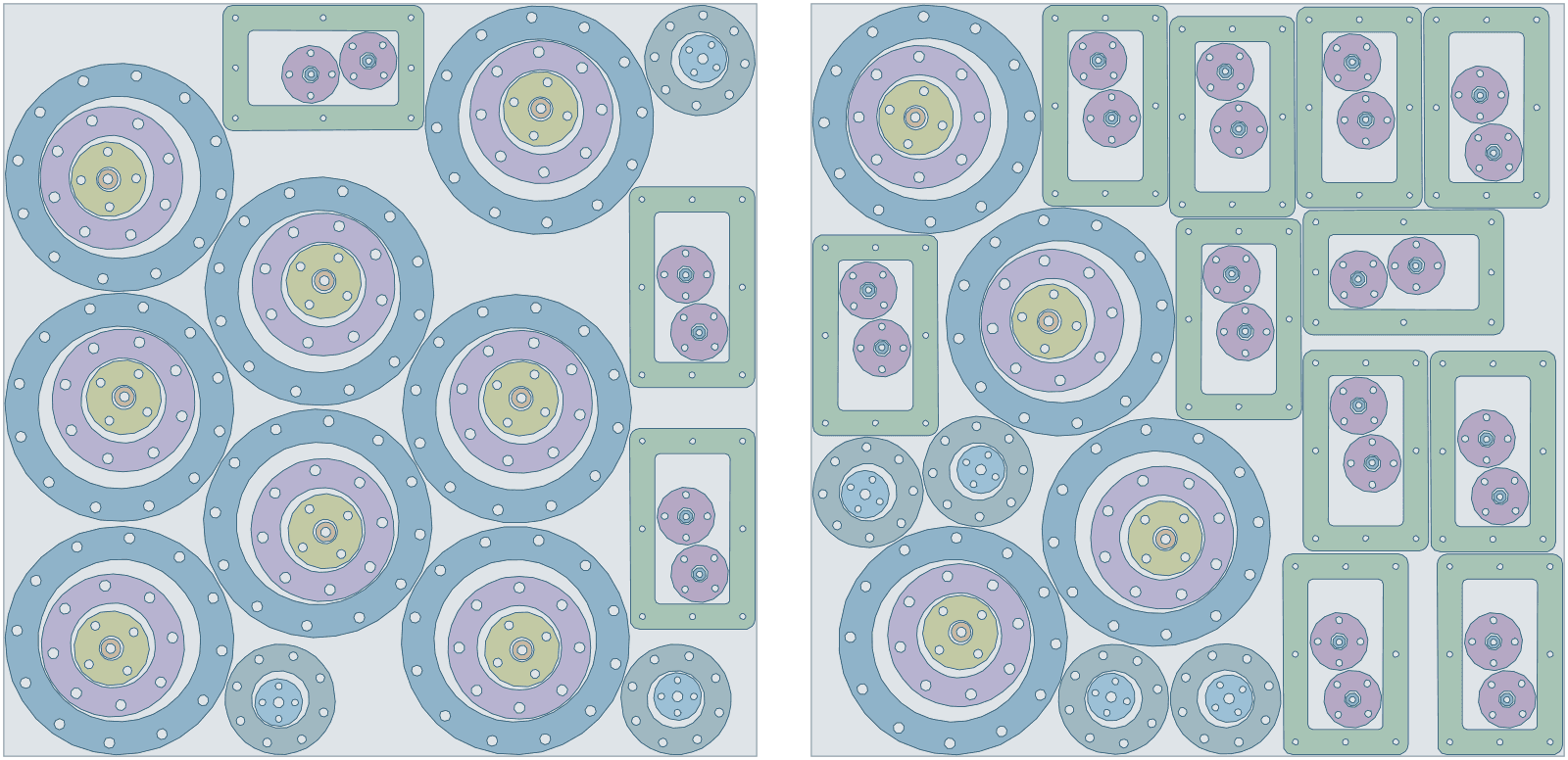
| Part | Per set | Rotation | Tilt | Mirror |
|---|---|---|---|---|
| ff-dn300 · 13 cut-outs | 4 | free | – | no |
| cover-gasket · 9 cut-outs | 6 | 90° steps | – | no |
| ff-dn200 · 13 cut-outs | 6 | free | – | no |
| ff-dn150 · 9 cut-outs | 4 | free | – | no |
| ff-dn100 · 9 cut-outs | 8 | free | – | no |
| ff-dn80 · 9 cut-outs | 6 | free | – | no |
| ff-dn40 · 5 cut-outs | 4 | free | – | no |
| ff-dn25 · 5 cut-outs | 12 | free | – | no |
| ff-dn15 · 5 cut-outs | 8 | free | – | no |
| washer-m20 · 1 cut-out | 10 | free | – | no |
| washer-m12 · 1 cut-out | 12 | free | – | no |
- complete sets
- 0
- material used
- 62.0%
- sheets used
- 2 of 2
- gap between parts
- 3 mm
- search time
- 2 min
Want to see how Lescut nests your own parts? Start a free trial or send us your parts.
The problem
Most of a gasket is the hole in the middle
Bores are material
The bore of a DN300 gasket is a disc of 324 mm. Cut out and thrown away, it is a large share of the sheet. Cut into smaller gaskets, it is not.
Many sizes, small quantities
Gasket orders mix many sizes in small numbers and change daily. Nesting them by hand, inside one another, takes longer than cutting.
Expensive sheet
PTFE, graphite and high-grade compressed fibre sheet cost enough that every disc matters.
Applications
Where gasket nesting software is used
Flange gaskets
Full-face and ring gaskets nested inside each other's bores.
Rubber parts and seals
EPDM, NBR, neoprene and silicone parts with free rotation.
Thermal and insulation gaskets
Graphite and fibre gaskets for heat exchangers and exhausts.
HVAC and enclosure seals
Frame gaskets with large windows filled by small parts.
Pump and valve gaskets
Odd-shaped gaskets and their small seals in one job.
Foam gaskets and pads
Foam and felt parts from sheet stock.
Settings to start from
A starting point for gaskets and seals
Rules per part come from text in your file (NAME, QTY, GRADE, ROT, TILT, FLIP) or the parts table; the rest is saved once in a nesting profile that starts every job.
| For | Setting | Why |
|---|---|---|
| Sheet sizes and goal | each size with its price; lowest material cost | a job can mix sizes and aim for the lowest cost instead of the fewest sheets |
| Round gaskets in rubber or PTFE | ROT:ANY | free rotation fills the most space |
| Compressed fibre sheet | ROT:90 or ROT:180 | follow the sheet's direction where the material's strength depends on it |
| Bolt holes and bores | closed outlines inside the part | cut, and filled with smaller gaskets |
| Gap | 2–3 mm for knife, more for waterjet | the kerf of your cutter |
Preparing your files
From your CAD to Lescut
Lescut reads DXF and SVG from any CAD system. Each closed outline is a gasket and each closed outline inside it a hole.
- Draw bores and bolt holes as closed circles on the same cut layer as the outline.
- Put part numbers on TEXT and any marking on MARK: they travel with the gasket.
- Give quantities as QTY text inside the gasket, or set them in the parts table.
Good to know
What Lescut does not do
- Sheets only: rubber and foam from the roll are nested with fabric nesting, a separate Lescut organization.
- Offcuts are not stored as stock yet.
- It returns cutting files; it does not drive the cutter or plan the cut order.
Savings
What better nesting is worth in gaskets and seals
The same parts need the same area of material however they are nested, so a better yield means buying less of it. Gasket sheet such as PTFE, graphite or high-grade fibre is expensive, and the bores of large gaskets are where the material goes. The starting figures are an example for a gasket cutter; enter your own.
55% today → 60.0% with nesting. This is your assumption; the trial measures it on your own files.
Engine time: how the plan is chosen
A day's order of sheets nests well in a job of 1 to 5 minutes; longer jobs can save a further sheet. Your monthly volume divided by this gives the jobs a month, and the calculator picks the cheapest plan whose engine minutes and job length cover them.
The yield gain is your assumption; the trial measures it on your own files. More on how the sheet savings calculator works.
Pricing
Gasket nesting software plans, free for 7 days
Every plan starts with a 7-day free trial with engine minutes to nest your own parts against the sheets you would have used. Add a card when you sign up; you are charged only if you keep the plan.
Sheet Starter
€29 per month
120 engine minutes, 8 vCPU per job, jobs up to 2 min
- Sheet nesting: fewest sheets or lowest material cost
- Several sheet sizes in one job
- Rotation, grain and flip rules per part
- Part-in-part nesting
- DXF / SVG in, DXF / SVG out, layers kept
- Complete sets for kits
- 1 user
€0 for 7 days. Card required. Cancel any time.
Extra engine minutes are €0.50 each, with up to 30% off. All sheet nesting plans.
Gasket nesting software: questions
Does Lescut place small gaskets inside large ones automatically?
Yes. Every closed outline inside a part is a cut-out, and any smaller part of the order that fits with the gap may be nested inside it.
Which materials can I nest?
Anything in sheets: compressed fibre, rubber (EPDM, NBR, neoprene, silicone), PTFE, graphite, cork, felt and foam sheet.
Can I nest gaskets from a roll of rubber?
Yes, with fabric nesting, which nests on a roll of fixed width. It is a separate Lescut organization under the same login.
Can orders come straight from our webshop?
Yes, through the REST API on Pro and Enterprise plans: send the parts with the job, start it, and fetch the cutting files when it is done.