A real nest
1 dinghy kit on 4 sheets of marine plywood, 81% used
A 4 m stitch-and-glue dinghy: side and bottom panels each cut in two with puzzle joints, three bulkheads with lightening holes, transom, seats, breasthook and gussets, 21 parts a kit, on 2440 × 1220 mm sheets with a 6 mm gap for the router bit. Panels keep the face grain along their length; port and starboard are the same panel, flipped. The order asked for more kits than 4 sheets hold, so with prefer complete sets Lescut placed 1 whole kit and filled the leftover with 12 parts of the next ones.
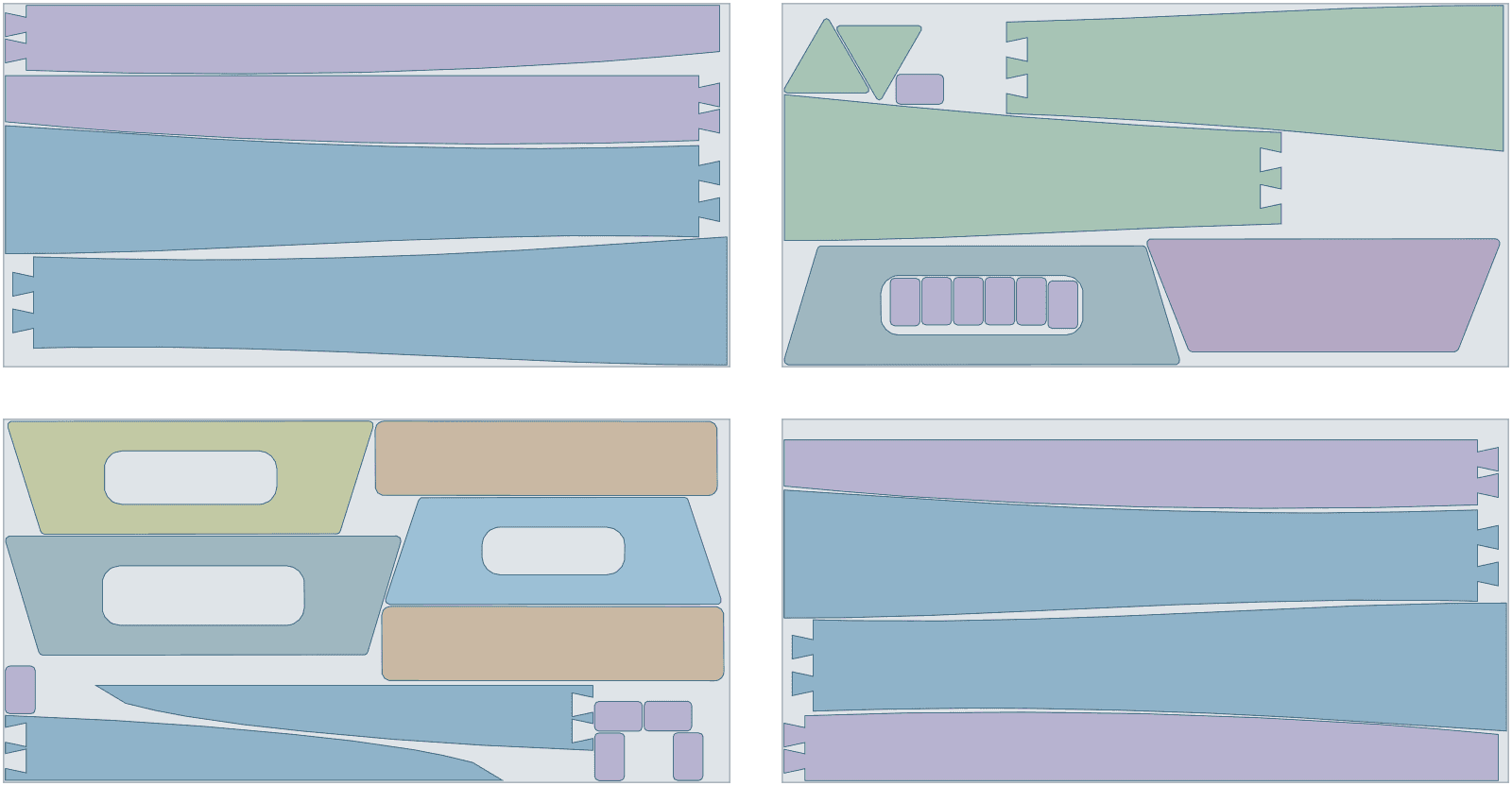
| Part | Per set | Rotation | Tilt | Mirror |
|---|---|---|---|---|
| side-aft | 2 | 180° steps | – | allowed |
| side-fore | 2 | 180° steps | – | allowed |
| bottom-aft | 2 | 180° steps | – | allowed |
| bulkhead-2 · 1 cut-out | 1 | 180° steps | – | no |
| bulkhead-1 · 1 cut-out | 1 | 180° steps | – | no |
| transom | 1 | 180° steps | – | no |
| bulkhead-3 · 1 cut-out | 1 | 180° steps | – | no |
| seat | 2 | 180° steps | – | no |
| bottom-fore | 2 | 180° steps | – | allowed |
| breasthook | 1 | 180° steps | – | no |
| gusset | 6 | 90° steps | – | no |
- complete sets
- 1
- material used
- 80.5%
- sheets used
- 4 of 4
- gap between parts
- 6 mm
- search time
- 5 min
Want to see how Lescut nests your own parts? Start a free trial or send us your parts.
The problem
Panels longer than the sheet
Hull panels are long and curved
Side and bottom panels run the length of the boat, longer than a sheet, so they are split and joined. How they are split and where they go decides how many sheets a kit needs.
Port and starboard
Most panels come as a mirrored pair. Plywood can be flipped, so one drawing serves both, if the nesting allows it.
Grain matters on the outside
Hull panels should run with the face veneer's grain for strength and finish; bulkheads and small parts can turn.
Applications
Where boat kit nesting software is used
Kayaks and canoes
Long, narrow stitch-and-glue panels split with puzzle joints, nested on 2440 × 1220 sheets.
Dinghies and tenders
Hull panels, bulkheads and seats of a small boat kit.
Plywood powerboats
Frames, stringers and hull panels in thicker ply.
Boat interiors
Bulkheads, bunks and cabinetry in marine ply.
Kit makers and plan designers
Nest every kit you sell on the fewest sheets, with the same DXF for any router.
Teardrop trailers and camper conversions
Plywood walls, floors and furniture panels with cut-outs for windows and doors.
Settings to start from
A starting point for boat building
Rules per part come from text in your file (NAME, QTY, GRADE, ROT, TILT, FLIP) or the parts table; the rest is saved once in a nesting profile that starts every job.
| For | Setting | Why |
|---|---|---|
| Sheet sizes and goal | each size with its price; lowest material cost | a job can mix sizes and aim for the lowest cost instead of the fewest sheets |
| Hull panels | ROT:180, FLIP:Y | face grain along the panel; one drawing for port and starboard |
| Bulkheads, transom | ROT:180, FLIP:N | grain one way, the good face where it shows |
| Gussets and small parts | ROT:90 | fill the gaps and lightening holes |
| Gap | bit diameter plus 1–2 mm | a 6 mm bit needs 7–8 mm |
| Marks | MARK layer | stitch holes and station lines travel with the panel |
Preparing your files
From your CAD to Lescut
Lescut reads DXF and SVG; each closed outline is a part, each closed outline inside it a cut-out.
- Split panels longer than the sheet in your CAD, with puzzle or scarf joints; Lescut nests the pieces as drawn.
- Put stitch-hole positions and station marks on MARK or DRILL so they are marked, not cut out.
- Allow FLIP:Y on panels that come as a mirrored pair.
Good to know
What Lescut does not do
- Lescut does not develop hull panels or split them into puzzle joints: draw that in your CAD.
- It does not write toolpaths or tabs: your CAM does.
Savings
What better nesting is worth in boat building
The same parts need the same area of material however they are nested, so a better yield means buying less of it. Marine plywood is among the dearest sheet materials, and a kit that fits one sheet fewer saves that sheet on every kit. The starting figures are an example for a kit maker; enter your own.
70% today → 75.0% with nesting. This is your assumption; the trial measures it on your own files.
Engine time: how the plan is chosen
A day's order of sheets nests well in a job of 1 to 5 minutes; longer jobs can save a further sheet. Your monthly volume divided by this gives the jobs a month, and the calculator picks the cheapest plan whose engine minutes and job length cover them.
The yield gain is your assumption; the trial measures it on your own files. More on how the sheet savings calculator works.
Pricing
Boat kit nesting software plans, free for 7 days
Every plan starts with a 7-day free trial with engine minutes to nest your own parts against the sheets you would have used. Add a card when you sign up; you are charged only if you keep the plan.
Sheet Starter
€29 per month
120 engine minutes, 8 vCPU per job, jobs up to 2 min
- Sheet nesting: fewest sheets or lowest material cost
- Several sheet sizes in one job
- Rotation, grain and flip rules per part
- Part-in-part nesting
- DXF / SVG in, DXF / SVG out, layers kept
- Complete sets for kits
- 1 user
€0 for 7 days. Card required. Cancel any time.
Extra engine minutes are €0.50 each, with up to 30% off. All sheet nesting plans.
Boat kit nesting software: questions
Can one drawing give port and starboard panels?
Yes. Allow flipping (FLIP:Y) on the panel and give it a quantity of two; the engine places one as drawn and one mirrored where that fits best.
Can panels longer than the sheet be nested?
Split them into pieces with puzzle or scarf joints in your CAD first; Lescut then nests the pieces like any other part.
Do you sell boat plans or cut files?
No. Lescut nests the parts you have; designers and kit makers use it to nest their own kits.